
共振衰变核子形成氘核和反氘核的观测
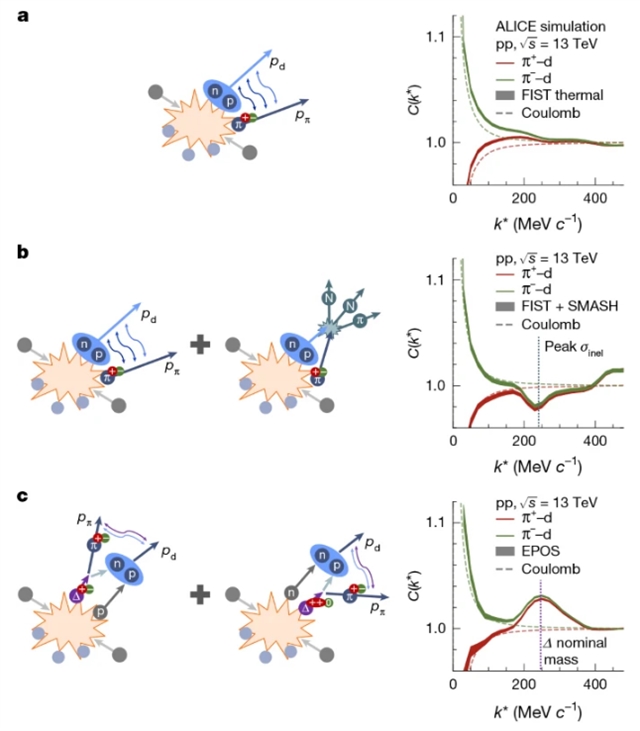
近日,ALICE国际协作组报道了共振衰变核子形成氘核和反氘核的观测。2025年12月10日,《自然》杂志发表了该成果。
高能强子碰撞产生的环境温度超过100兆电子伏特,比太阳中心温度高出约十万倍。因此,目前尚不清楚结合能仅为数兆电子伏特、质量数A为几个单位的轻(反)原子核(如氘核、氦-3或氦-4)如何能从这类碰撞中产生。
该研究中,ALICE合作组通过分析质子-质子(pp)碰撞中的氘核-π介子动量关联性,提供了不依赖于模型的证据:约90%观测到的(反)氘核产生于短寿命共振态(如Δ(1232))衰变后的核反应过程。这些在大型强子对撞机上获得的研究成果,填补了学界对超相对论强子碰撞中核合成机制的理解空白。该发现不仅揭示了(反)原子核在强子碰撞中的形成机制,其结论还可用于模拟宇宙射线中轻重原子核的产生过程以及暗物质衰变事件。
附:英文原文
Title: Observation of deuteron and antideuteron formation from resonance-decay nucleons
Author: anonymous
Issue&Volume: 2025-12-10
Abstract: High-energy hadronic collisions generate environments characterized by temperatures above 100MeV (refs.1,2), about 100,000 times hotter than the centre of the Sun. At present, it is therefore unclear how light (anti)nuclei with mass number A of a few units, such as the deuteron, 3He or 4He, each bound by only a few MeV, can emerge from these collisions3,4. Here, the ALICE Collaboration reports that deuteron–pion momentum correlations in proton–proton (pp) collisions provide model-independent evidence that about 90% of the observed (anti)deuterons are produced in nuclear reactions5 following the decay of short-lived resonances, such as the Δ(1232). These findings, obtained by the ALICE Collaboration at the Large Hadron Collider, resolve a gap in our understanding of nucleosynthesis in ultrarelativistic hadronic collisions. Apart from offering insights on how (anti)nuclei are formed in hadronic collisions, the results can be used in the modelling of the production of light and heavy nuclei in cosmic rays6 and dark-matter decays7,8.
DOI: 10.1038/s41586-025-09775-5
Source: https://www.nature.com/articles/s41586-025-09775-5