
地幔上升流中熔化的普遍概念
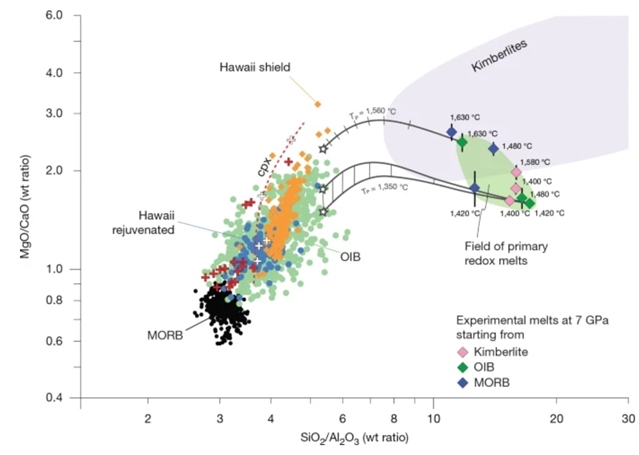
近日,瑞士苏黎世理工学院Max W. Schmidt团队研究了地幔上升流中熔化的普遍概念。2026年2月4日出版的《自然》杂志发表了这项成果。
深部地幔熔融标志着地球分异作用的开始,然而对于浮力驱动的地幔上涌流如何触发熔融,以及这些初始熔体在软流圈内如何演化,一直缺乏统一的理论框架。研究组表明,在任何固态地幔上涌过程中产生的首批熔体均为富含二氧化碳的金伯利质硅酸盐熔体,它们形成于约250公里深度,通过元素碳氧化为二氧化碳的过程产生。该实验将源自地幔柱或广泛上涌流(包括金伯利岩、洋岛玄武岩及洋中脊玄武岩)的一系列地表熔体,置于7 GPa压力下的绝热与超绝热条件中与肥沃地幔达到平衡。
实验结果构建了一个理论框架:深部的氧化还原熔融普遍产生金伯利质熔体,这些熔体通过反应性多孔流动在软流圈中上升时,演化出更高程度的熔融、更少的挥发分与不相容元素,但二氧化硅含量增加。随后,岩石圈中的通道化流动可能使这些熔体被直接萃取——在碳元素转化为二氧化碳的氧化还原界面上方即进入岩石圈的区域形成金伯利岩;在岩石圈厚度为150-100公里的区域形成碱性硅不饱和板内岩浆;而在洋中脊下方,当大规模"干性"熔融占主导时,则形成拉斑玄武岩。该框架与洋中脊下方约250公里处广泛分布的地震低速带观测结果相符,并能解释洋岛玄武岩和洋中脊玄武岩以不同熔融程度、不同比例取样地幔中多种地球化学组分的现象。
附:英文原文
Title: A universal concept for melting in mantle upwellings
Author: Schmidt, Max W., Paneva, Nadia, Giuliani, Andrea
Issue&Volume: 2026-02-04
Abstract: Deep mantle melting marks the onset of Earth differentiation1, yet a unifying framework for how buoyancy-driven mantle upwellings initiate melting and how such incipient melts evolve within the asthenosphere has remained elusive. Here we show that the first melts generated in any solid-state mantle upwelling are kimberlitic CO2-rich silicate melts that form at about 250km depth through oxidation of elemental carbon to CO2 (refs.2,3). Our experiments force a range of surface melts, derived from mantle plumes4 or broad upwellings5 (kimberlites, ocean island basalts and mid-ocean ridge basalts), into equilibrium with fertile mantle at adiabatic and super-adiabatic conditions at 7GPa. The results define a framework in which redox melting at depth universally yields kimberlitic melts, which, while ascending through the asthenosphere by reactive porous flow6,7, evolve to higher degrees of melting, lesser volatiles and incompatible elements, but higher SiO2. Channelized flow7 in the lithosphere may then enable direct extraction of these melts, leading to kimberlites, where the lithosphere commences just above the C→CO2 redox front, to alkaline Si-undersaturated intraplate magmas where lithospheric thicknesses are 150–100km, and to tholeiitic basalts below mid-ocean ridges where voluminous ‘dry’ melting becomes overwhelming. This framework is consistent with the widespread seismic low-velocity zone at about 250km beneath mid-ocean ridges8,9 and aligns with ocean island and mid-ocean ridge basalts sampling the various geochemical mantle components at different degrees of melting in different proportions10,11.
DOI: 10.1038/s41586-025-10065-3
Source: https://www.nature.com/articles/s41586-025-10065-3