
表面优化控制着物理网络的局部设计
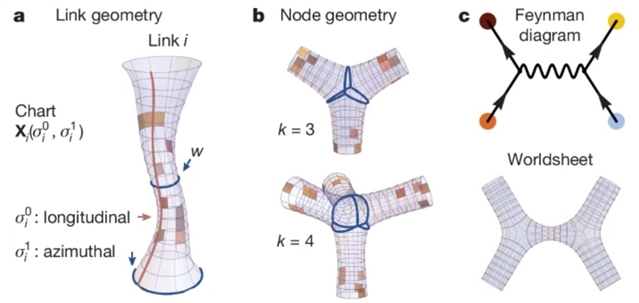
近日,美国东北大学Barabsi, Albert-Lszl团队发现了表面优化控制着物理网络的局部设计。2026年1月7日出版的《自然》杂志发表了这项成果。
大脑的连接组和血管系统是物理网络的例子,其有形性质影响着它们的结构、布局,并最终影响其功能。构建和维护这些网络所需的物质资源激发了数十年来对布线经济的研究,这些研究为预测其预期架构和组织提供了可检验的预测结果。
研究组实证探索了一系列物理网络的局部分支几何结构,揭示了长期以来关于布线最小化预测的系统性违反。这促使学界提出假设:预测物理网络的真实物质成本需要人们考虑其完整的三维几何结构,从而产生了一个在很大程度上难以解决的优化问题。然而,研究组发现表面最小化与弦论中的高维费曼图存在精确映射,预测随着链接厚度的增加,局部树状网络会经历一种转变,变成无法再通过长度最小化来解释的配置。
具体而言,表面最小化预测了三叉点和分支角度的出现,这与广泛应用领域中物理网络的局部树状组织高度一致。最后,研究组预测存在稳定的正交萌芽,这些萌芽不仅在真实网络中普遍存在,而且在功能上发挥着关键作用,能改善大脑中的突触形成以及植物和真菌中的养分获取。
附:英文原文
Title: Surface optimization governs the local design of physical networks
Author: Meng, Xiangyi, Piazza, Benjamin, Both, Csaba, Barzel, Baruch, Barabsi, Albert-Lszl
Issue&Volume: 2026-01-07
Abstract: The brain’s connectome1,2,3 and the vascular system4 are examples of physical networks whose tangible nature influences their structure, layout and, ultimately, their function. The material resources required to build and maintain these networks have inspired decades of research into wiring economy, offering testable predictions about their expected architecture and organization. Here we empirically explore the local branching geometry of a wide range of physical networks, uncovering systematic violations of the long-standing predictions of wiring minimization. This leads to the hypothesis that predicting the true material cost of physical networks requires us to account for their full three-dimensional geometry, resulting in a largely intractable optimization problem. We discover, however, an exact mapping of surface minimization onto high-dimensional Feynman diagrams in string theory5,6,7, predicting that, with increasing link thickness, a locally tree-like network undergoes a transition into configurations that can no longer be explained by length minimization. Specifically, surface minimization predicts the emergence of trifurcations and branching angles in excellent agreement with the local tree organization of physical networks across a wide range of application domains. Finally, we predict the existence of stable orthogonal sprouts, which are not only prevalent in real networks but also play a key functional role, improving synapse formation in the brain and nutrient access in plants and fungi.
DOI: 10.1038/s41586-025-09784-4
Source: https://www.nature.com/articles/s41586-025-09784-4