
高温环境下超分子有机纳米颗粒的检测
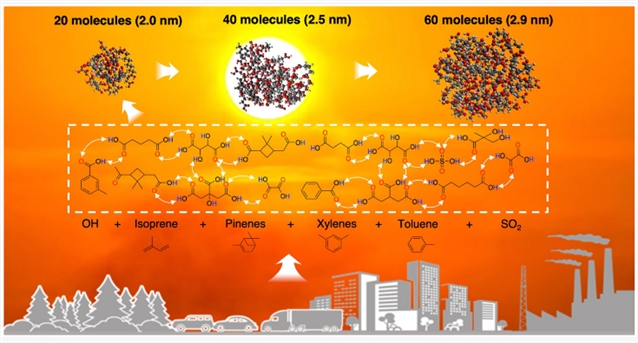
美国得克萨斯农工大学Renyi Zhang团队研究了高温环境下超分子有机纳米颗粒的检测。2026年2月12日出版的《科学》杂志发表了这项成果。
新粒子形成是对流层细颗粒物的重要来源。普遍观点认为,新粒子形成在热力学上依赖于凝结物种的挥发性,且高温条件不利于此过程。
通过密集的外场观测,研究组在热浪期间频繁观测到新粒子形成事件,并首次测量了低至3纳米的粒径分辨纳米粒子化学组成,揭示出羧酸类物质的主导作用。该研究揭示了有机酸通过自组装形成超分子纳米粒子的自发机制。这一发现不仅解释了高温条件下反常的新粒子形成现象,也阐明了其在多样化大气条件下普遍存在的成因。随着全球变暖导致热浪事件愈发频繁剧烈,该研究为评估气溶胶对云形成、公共健康及气候的影响开辟了新途径。
附:英文原文
Title: Detecting supramolecular organic nanoparticles during heat wave
Author: Renyi Zhang, Yixin Li, Jiayun Zhao, Bianca Aridjis-Olivos, Lijun Zhao, Veronica Kowalewski, Maisha Kabir, Natalie M. Johnson, Erik R. Nielsen, Sarah D. Brooks, Yue Zhang, Arnold Vedlitz, Weston Porter, Simon W. North, Wanhe Li, Michael W. Young, John H. Seinfeld, Yuhan Wang, Yuan Wang
Issue&Volume: 2026-02-12
Abstract: New particle formation (NPF) represents a major source of tropospheric fine aerosols. A common viewpoint is that NPF hinges thermodynamically on the volatility of condensing species and is unfavorable at high temperatures. From an intensive field campaign, we observed frequent NPF events during a heat wave. Size-resolved chemical composition of nanoparticles down to 3 nanometers was first measured, unraveling a dominant presence of carboxylic acids. Our work uncovers a spontaneous mechanism to produce supramolecular nanoparticles through self-assembly of organic acids. This discovery explains not only the unexpected NPF at high temperatures but also its ubiquitous occurrence under diverse atmospheric conditions. As global warming leads to more frequent and intense heat waves, our findings open avenues for assessing the impacts of aerosols on cloud formation, public health, and climate.
DOI: ady5192
Source: https://www.science.org/doi/10.1126/science.ady5192