
大地震的发生和小地震一样是随机的
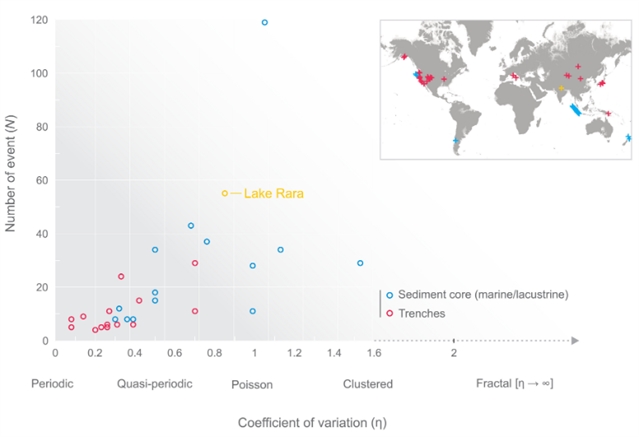
比利时布鲁塞尔自由大学Zakaria Ghazoui团队报道了大地震的发生和小地震一样是随机的。相关论文于2026年2月13日发表在《科学-进展》杂志上。
地震危害评估依赖于特定震级地震间的时间间隔分布。在喜马拉雅地区,复发间隔通常被模拟为周期性或准周期性,而全球范围内,地震复发模式则包括周期性、丛集性和随机性。
研究组通过对一个六千年湖泊沉积物地震记录进行统计分析,并结合区域仪器数据、全球古地震记录和合成地震目录进行校准,结果表明,大地震(基于局部校准的地震动强度阈值,M ≥ 6.5)的时间间隔稳健地遵循泊松分布。其二阶波动则指示了事件丛集性。
这些观测结果与周期性或准周期性复发模型相矛盾。与其他构造环境的古地震数据及逼真的合成地震目录的比较,证实了这些发现的稳健性和广泛适用性。因此,大地震似乎与小地震一样具有随机性,这一发现挑战了基于有限数据集推导的复发模型,并显著提高了地震危害评估。
附:英文原文
Title: Occurrence of major earthquakes is as stochastic as smaller ones
Author: Zakaria Ghazoui, Jean-Robert Grasso, Arnaud Watlet, Corentin Caudron, Abror Karimov, Yusuke Yokoyama
Issue&Volume: 2026-02-13
Abstract: Seismic hazard estimates rely on interevent time distributions between earthquakes of a given magnitude. In the Himalaya, recurrence intervals are usually modeled as cyclic or quasiperiodic, whereas globally, they range from periodic and clustered to random. Statistical analyses of a 6000-year lake-sediment seismic record, calibrated against regional instrumental data, worldwide paleoseismic records, and synthetic seismic catalogs, demonstrate that time intervals between large earthquakes (M ≥ 6.5, based on shaking intensity thresholds calibrated locally) robustly follow a Poisson distribution. Second-order fluctuations indicate event clustering. These observations contradict periodic or quasiperiodic recurrence models. Comparisons with paleoseismic data from other tectonic settings and realistic synthetic catalogs confirm the robustness and broad applicability of these findings. Thus, major earthquakes appear as stochastic as smaller ones, challenging recurrence models derived from limited datasets and substantially increasing seismic hazard estimates.
DOI: adx7747
Source: https://www.science.org/doi/10.1126/sciadv.adx7747